Standards-first workflows for your outpatient service.
The Clinic speaks the standards your integration team already works with — FHIR R4 validated in CI against the official HL7 validator, HL7 v2.5 with the full NABIDH event set, and a live DICOMweb server your imaging devices push to. Insurance rails are implemented per jurisdiction and activate once regulator enrollment completes.
Built on the standards, not around them.
Clinical events map to standard messages: FHIR R4 resources validated in CI, HL7 v2.5 messages linted and ACK-checked against DHA's NABIDH spec v4.9, and DICOM studies accepted straight from your devices.
Devices & payers
- Imaging devices & PACS
- Insurance rails & payers
- Health information exchange
The Clinic
- FHIR R4, CI-validated
- HL7 v2.5 publish pipeline
- DICOMweb — STOW · WADO · QIDO
Patients, clinicians, admins
- Patient portal
- Clinician app
- Admin console
Insurance rails and HIE connections are implemented per jurisdiction — NPHIES, eClaimLink and OHIP — and go live after the regulator's own enrollment and conformance testing.
Outpatient
Outpatient clinics, finally modern.
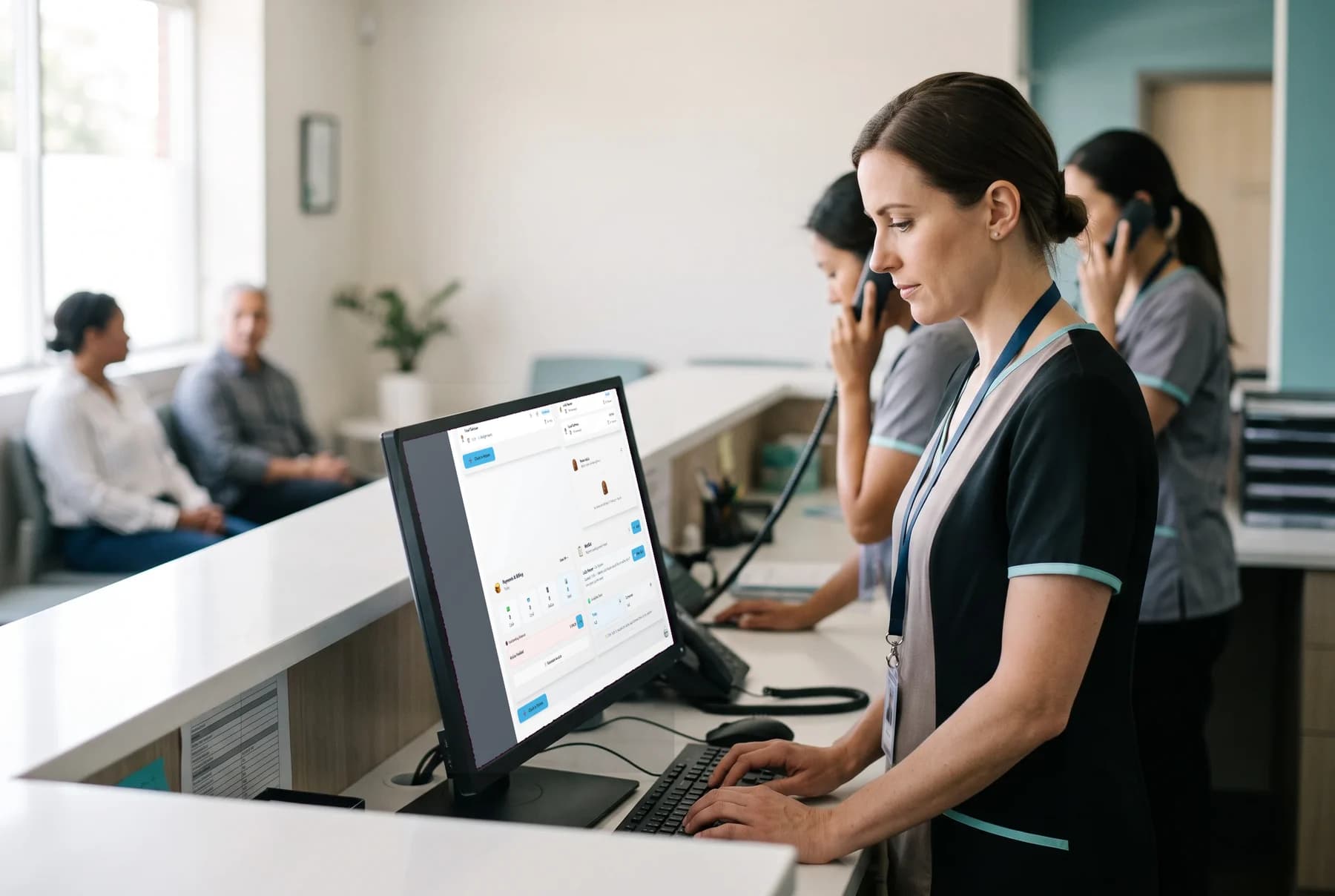
Most hospital systems were built for inpatient care. The Clinic gives outpatient and ambulatory teams fast scheduling, structured notes, and a patient experience that matches what people expect in 2026 — with every clinic's data strictly isolated at the database layer.
- Conflict-checked scheduling with waitlist auto-fill
- 24/7 self-booking with SMS, WhatsApp and email reminders
- Results and documents published to NABIDH over ORU and MDM
- Google sign-in or email and password, with admin-enforced two-factor
Specialty departments
Specialty departments, their own rules.
Dentistry and physiotherapy each get a purpose-built edition — tooth-level charting, perio exams and staged treatment plans on one side; a bilingual anatomy atlas, a 202-exercise library and adherence tracking on the other — without forking your install.
- Specialty editions configure tabs, defaults and features per clinic
- Imaging viewer with annotations and AI-assisted findings
- Devices pair once and push studies over DICOMweb (STOW-RS)
- Per-role permissions with restrict-only per-user overrides

Revenue cycle
Claims on the rail your regulator mandates.
NPHIES for Saudi Arabia, eClaimLink for Dubai and OHIP for Ontario are implemented in the product. NPHIES handles eligibility, pre-authorization, claims and remittance; eClaimLink files claims and prior requests; OHIP builds the MCEDT claim batch and transmits it once the ministry's conformance credentials are configured. Rail credentials are encrypted per clinic, and the regulator's own enrollment and conformance testing is the final gate before live claims.
- FHIR-based eligibility, pre-auth, claims and remittance on NPHIES
- eClaimLink (DHPO) claim filing and prior requests for Dubai
- OHIP builds the MCEDT claim batch for Ontario
- A readiness report shows exactly what's left before go-live
Built for the people who run hospital IT.
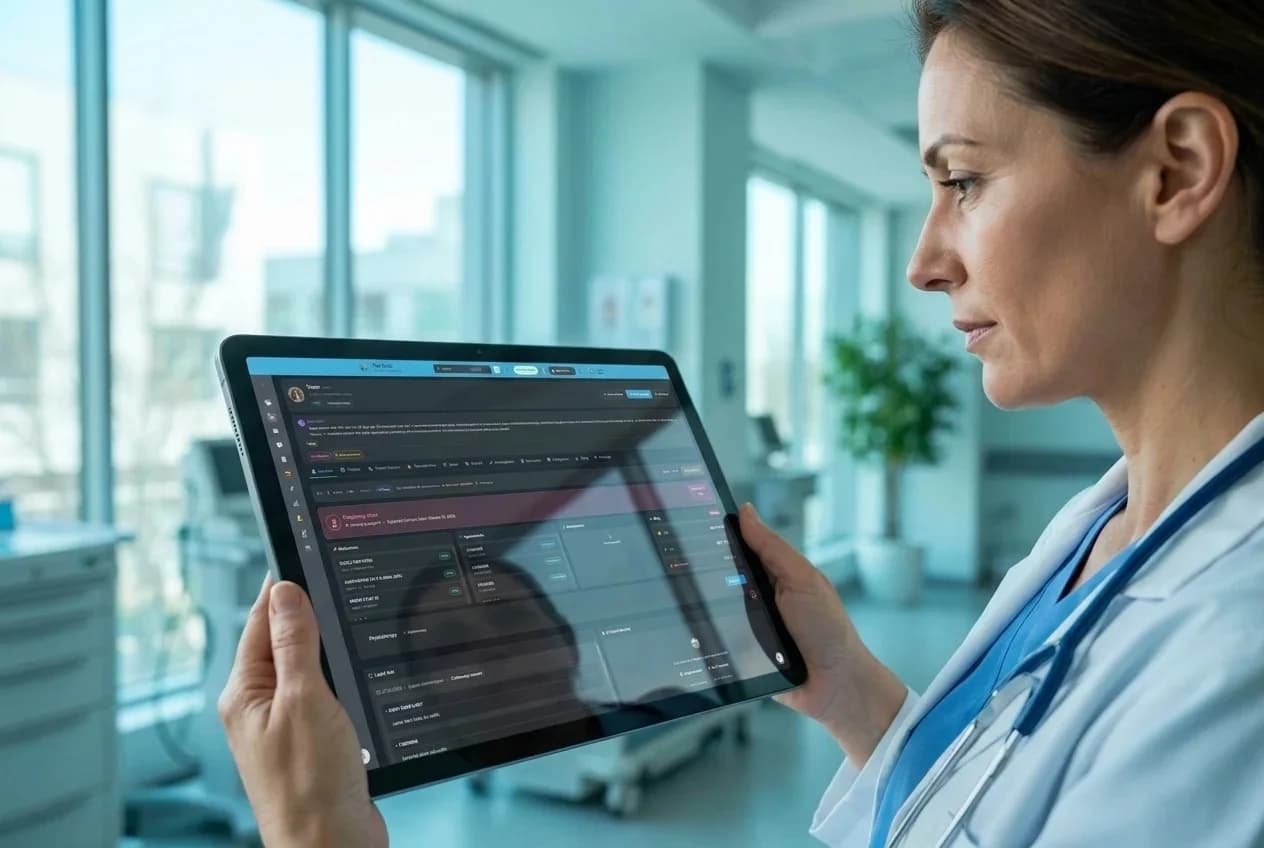
The integration, identity, and governance primitives your security and architecture teams expect — documented and auditable.
HL7 v2.5 messaging
The full NABIDH-mandated event set — ADT, ORU, MDM, VXU and PPR — with message linting and ACK parsing verified against DHA spec v4.9.
FHIR R4 builders
Clinical and claims resources built server-side and validated in CI against the official HL7 validator on every change.
Identity & access
Google sign-in or email and password. Central control over access: eleven roles, restrict-only per-user overrides, admin-forced two-factor with a grace period, and one session-timeout policy applied across every auth path.
DICOMweb imaging
STOW-RS ingest authenticated by per-device revocable tokens, WADO-RS retrieve and QIDO-RS search — paired in Settings, no VPN appliance.
Audit & retention
Administrative and sensitive events are recorded with full field persistence, and retention is enforced on a schedule by the platform — not by good intentions.
Tenant isolation
Every query is scoped to your clinic at the ORM layer and again by PostgreSQL row-level security, with per-clinic envelope encryption.
Audited, attested, and contract-ready.
- HL7 v2.5 event types in the NABIDH set
- 5HL7 v2.5 event types in the NABIDH set
- insurance rails implemented — NPHIES, eClaimLink, OHIP
- 3insurance rails implemented — NPHIES, eClaimLink, OHIP
- DICOMweb services — STOW, WADO, QIDO
- 3DICOMweb services — STOW, WADO, QIDO
- roles under one central permission registry
- 11roles under one central permission registry
The path to go-live.
Managed SaaS with strict per-clinic isolation. Here's how an outpatient service gets running — and what stays honest along the way.
Configure your jurisdiction
Regional settings drive the rails.
Set the clinic's jurisdiction and the platform selects the matching gateway, code sets and regional defaults. Rail credentials are stored encrypted, per clinic.
- Jurisdiction-aware gateway selection
- Encrypted per-clinic rail credentials
- Regional code sets and fee schedules
Connect devices and channels
Pair once, push forever.
Pair imaging devices for DICOMweb push, connect SMS, WhatsApp and email on your own credentials, and enforce two-factor for staff before the first patient is booked.
- DICOMweb device pairing with revocable tokens
- SMS, WhatsApp and email on clinic credentials
- Admin-enforced TOTP two-factor
Enroll with your regulator
Rails activate after enrollment.
NPHIES, eClaimLink and OHIP are implemented in the product. The regulator's enrollment and conformance testing is the final gate — the readiness report tracks every remaining gap.
- NPHIES — Saudi Arabia
- eClaimLink (DHPO) — Dubai
- OHIP — Ontario
Hospital IT questions
What integration teams ask first.
Which FHIR version does the platform support?
FHIR R4. Clinical and claims resources are built server-side and validated in CI against the official HL7 validator on every change, so a resource that breaks the spec fails the build instead of surfacing in your integration.
Can our imaging devices push studies directly?
Yes, over DICOMweb. Devices pair once in Settings and push studies with STOW-RS, authenticated by per-device tokens you can revoke. Retrieval is WADO-RS, search is QIDO-RS, and no VPN appliance sits in between.
Do you publish clinical events to a health information exchange?
The platform runs an outbound HL7 v2.5 publish pipeline covering the NABIDH-mandated event set — ADT, ORU, MDM, VXU and PPR — with message linting and ACK parsing checked against DHA spec v4.9. Results and documents are published to NABIDH over ORU and MDM messages.
How are insurance claims submitted?
The rail follows the clinic's jurisdiction: NPHIES for Saudi Arabia covers eligibility, pre-authorization, claims and remittance; eClaimLink files claims and prior requests for Dubai; OHIP builds the MCEDT claim batch for Ontario. Rails go live after the regulator's own enrollment and conformance testing, and a readiness report tracks what is left before go-live.
Can specialty departments run their own workflows?
Dentistry and physiotherapy run purpose-built editions — tooth-level charting, perio exams and staged treatment plans on one side; a bilingual anatomy atlas, a 202-exercise library and adherence tracking on the other. Editions configure tabs, defaults and features per clinic, without forking your install.

Ready to try The Clinic
See it run your clinic in 30 minutes.
Book a personalized demo. We'll use your clinic's real workflows — not a generic walkthrough.
No credit card. No slides. 30 minutes.