Physiotherapy · Ontario
Built for the way an Ontario physio clinic actually gets paid.
Ontario is not one billing rail. Extended health, auto insurance, WSIB and OHIP each answer to a different payer with different paperwork. The Clinic routes every claim to the right one, and says plainly where an electronic route does not yet exist.
- PHIPA network provider
- HIPAA-aligned controls
- Ontario payer routing
- Outcome measures and body map
- Guided data migration
What Ontario practice looks like
Four payers, four sets of paperwork, one record.
Most Ontario physiotherapy is paid privately or by an extended-health plan. Some is auto-insurance work governed by the Statutory Accident Benefits Schedule and filed on OCF forms. Some is WSIB. A smaller share is OHIP, and only at clinics designated for the publicly funded program. A single clinic commonly sees three of these in one week.
Software that treats Ontario as one rail gets this wrong. Here each claim resolves carrier to funding source to rail, so an extended-health claim, an auto claim and an OHIP claim for the same patient never land in the same file. Routing fails closed: an unresolved claim is never filed blind, and a manual route is a first-class outcome carrying a machine-readable reason rather than a silent failure.
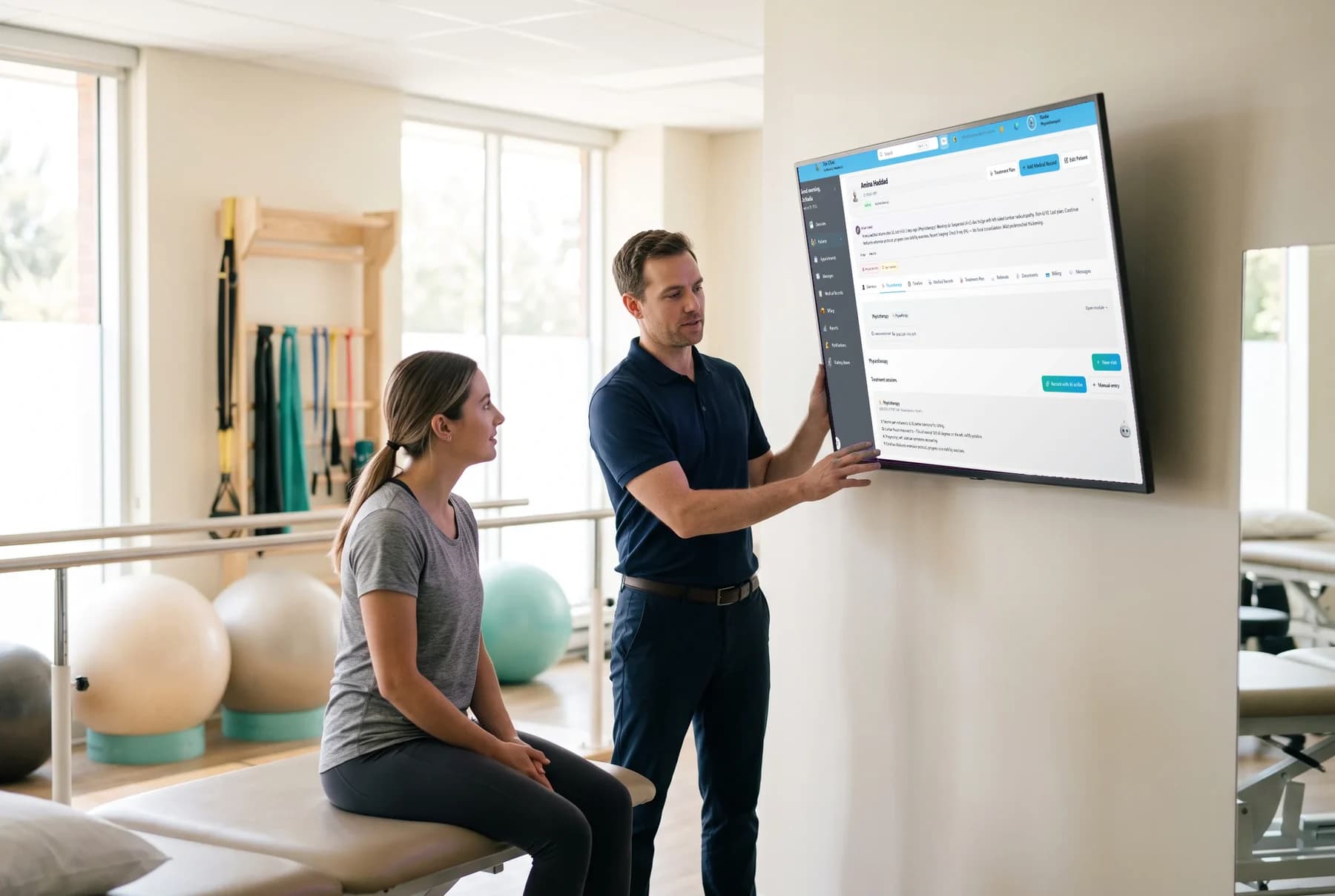
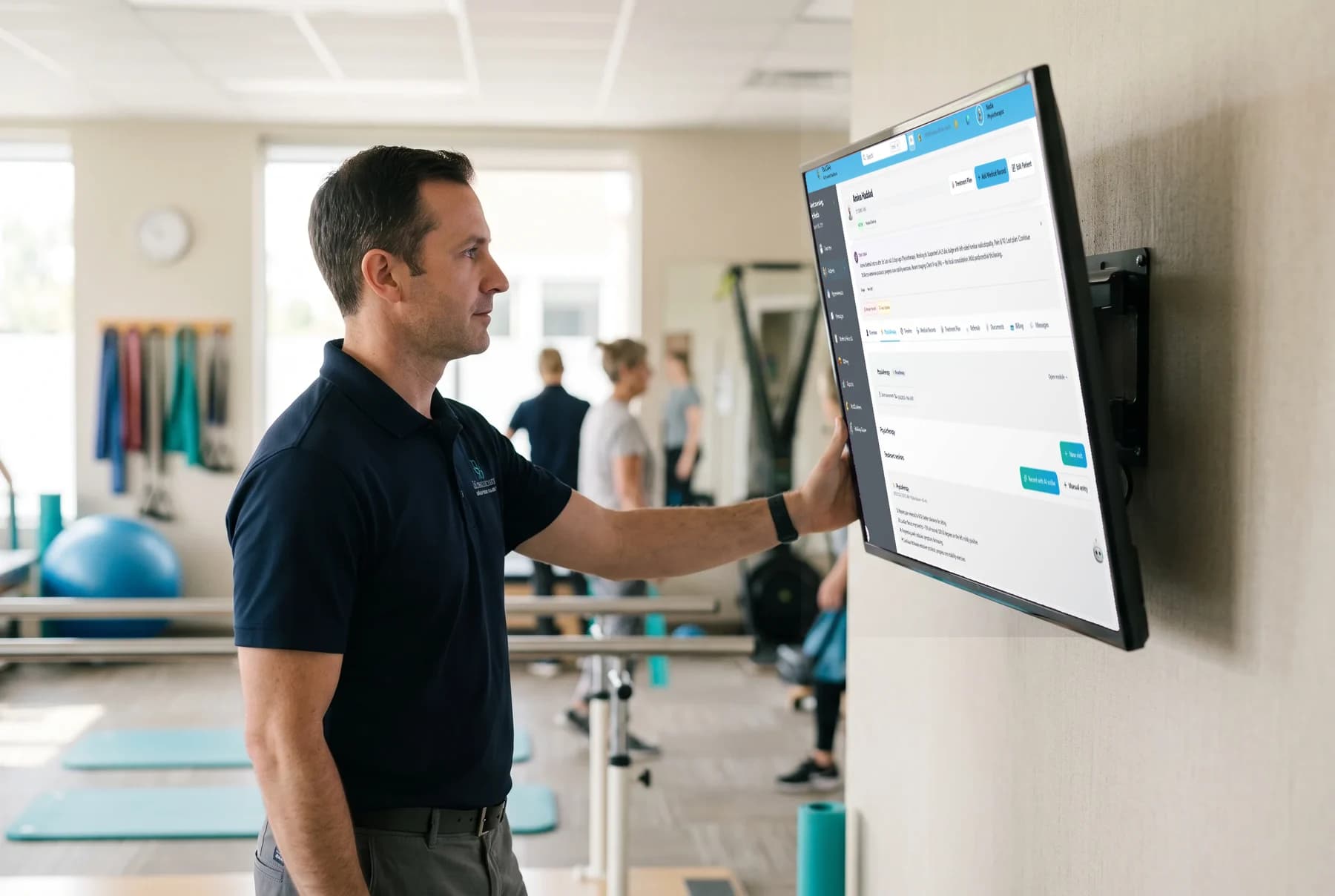
The record underneath is physiotherapy-native rather than a general EHR with a rehab tab bolted on. Assessments carry outcome measures that trend across the plan of care, the visit flowsheet carries forward from the previous session, and the home program goes out to the patient with its exercise videos attached.
The record
An assessment that trends, not a note that just sits there.
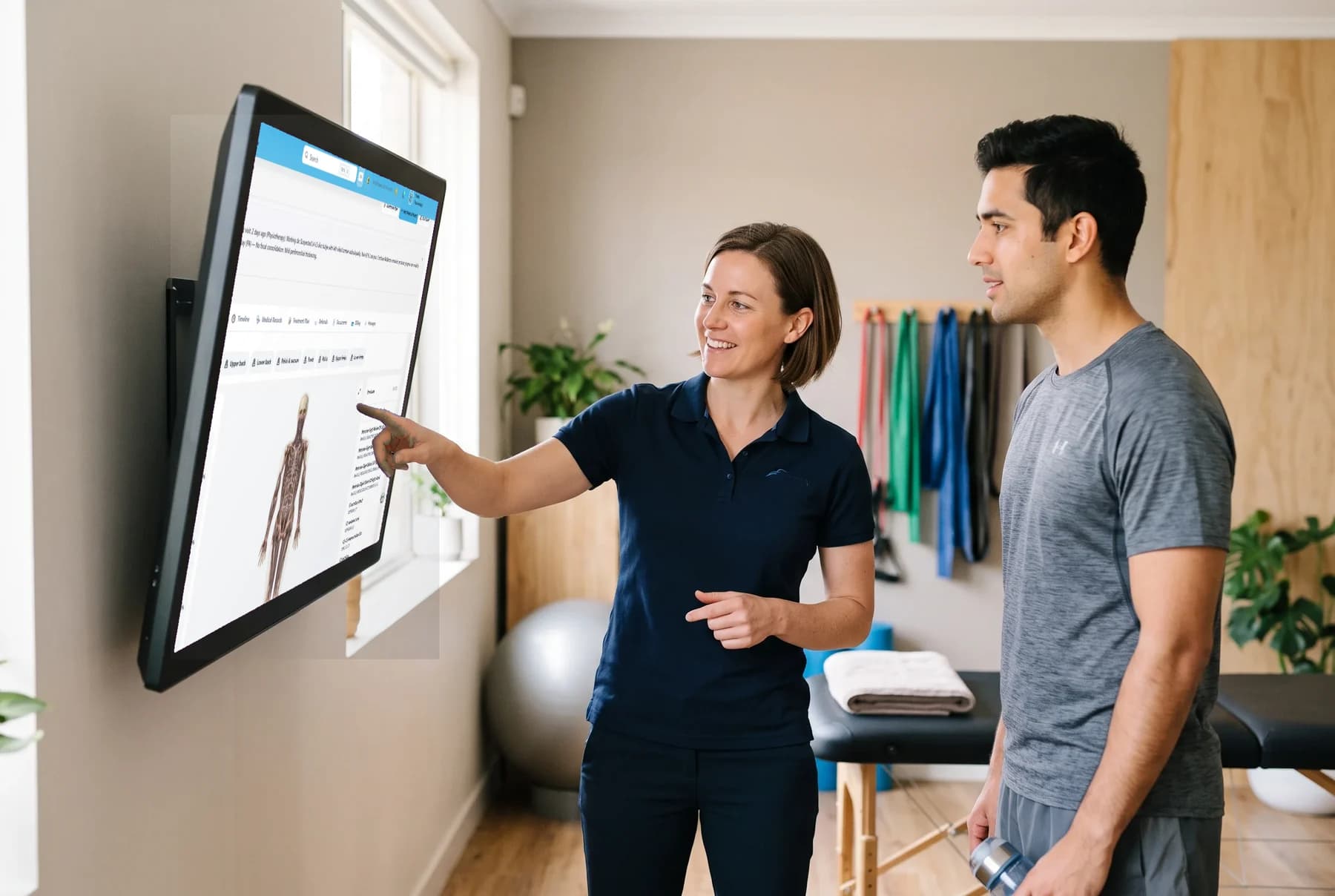
Assessments are backed by real assessment records with an interactive body map, outcome measures and trend tracking across the episode of care. Imaging and encounter findings land on the same body map. Each modality gets its own structured detail form rather than a free-text box, so what was actually done is queryable later instead of buried in prose.
- Interactive body map, with imaging and encounter findings placed on it
- Outcome measures captured per visit and trended across the plan of care
- Visit flowsheet that carries forward from the previous session, recording what was actually performed
- Structured detail per modality: physiotherapy, acupuncture, chiropractic, osteopathy and massage
Home program
The program leaves with the patient, and reports back.
A system exercise library spanning twenty-plus body regions and every category from strength to neuromotor, which your clinic can fork and extend with its own exercises. Programs are sent by email, WhatsApp or SMS and open on a tokenised page scoped to your clinic, and patient check-ins feed an adherence panel so a plan that has quietly stopped being followed is visible before the next review.
- System exercise library across twenty-plus body regions, forkable per clinic
- Curated video demonstrations attached to catalogue exercises
- Programs delivered by email, WhatsApp or SMS to a tokenised patient page
- Check-ins feed an adherence panel and trend chart, with per-patient reminder control
Getting paid
Every claim resolves to a payer before it goes anywhere.
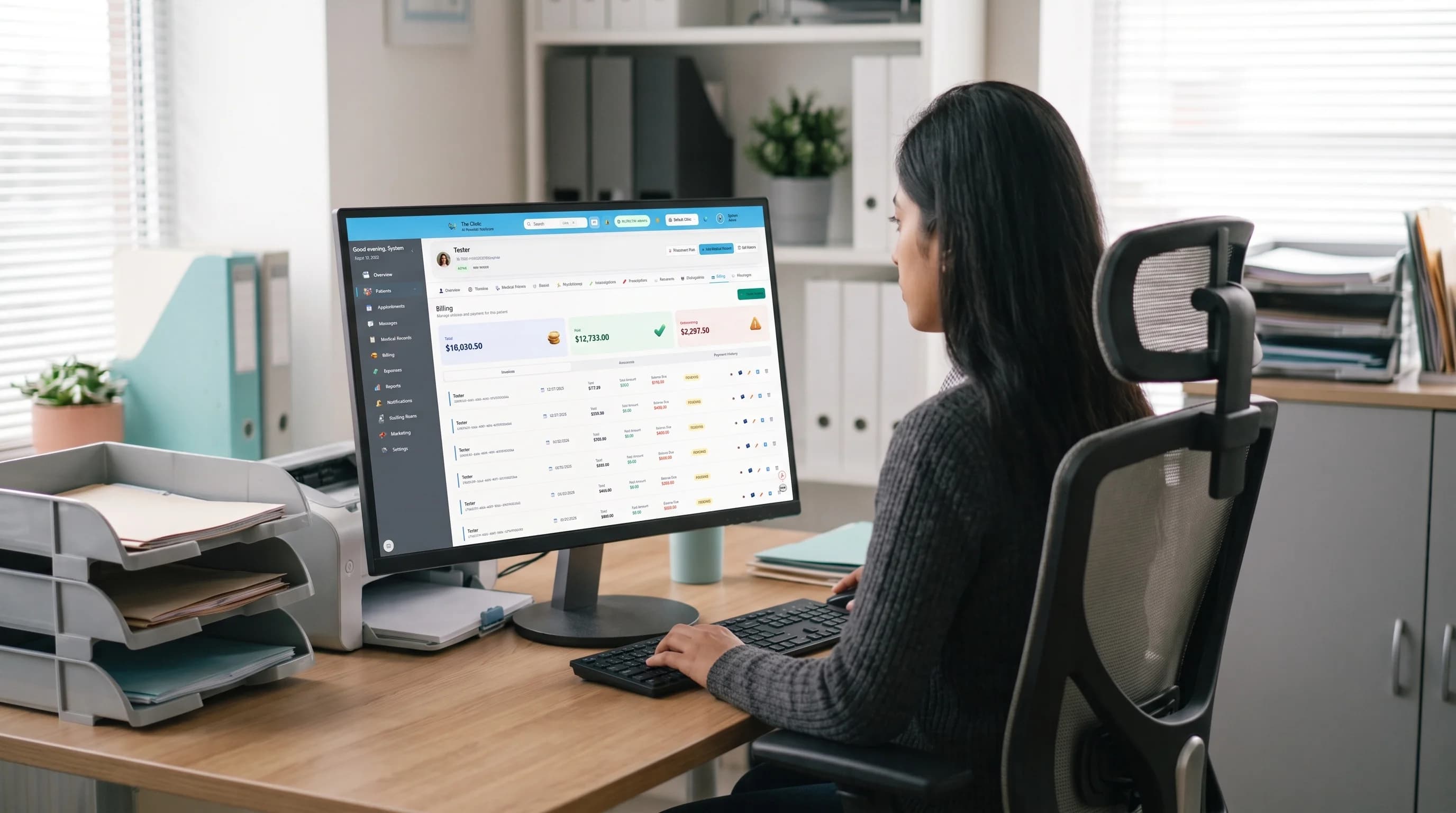
The carrier directory decides carrier, funding source and rail for each claim, and it does so per discipline: a massage therapist at a clinic whose physiotherapists are enrolled with a plan is not thereby enrolled. Ontario's funding sources are modelled separately, and a readiness report names every credential still missing rather than letting you discover it at submission time.
- Carrier, funding source and rail resolved per claim, and per discipline
- Extended health, auto, WSIB, OHIP and self-pay modelled as distinct funding sources
- Electronic rails, carrier portals and manual filing are all first-class outcomes with reasons
- A readiness report lists the gaps up front instead of failing at submission
Ontario rail status, stated plainly
- PHIPA
- network provider role
- MCEDT
- OHIP channel, built
- OCF
- routed, filed in HCAI
- eClaims
- built, awaiting certification
Before your first claim
What an Ontario clinic sets up.
Two of Ontario's rails are gated by a third party rather than by software. Here is the whole list, including the parts no vendor can shorten.
- 01
Jurisdiction
Set the clinic's jurisdiction to Ontario, Canada in Regional Settings. That is what puts its claims on the Ontario rails rather than a Gulf or US payer, and what selects the Ontario identity rules, including the health card and its version code.
- 02
Carrier directory
Record which plans your practitioners are enrolled with, per discipline and with effective dates. Enrolment moves: a carrier that left one rail on a given date is a different route before and after it.
- 03
Provider registration (OHIP)
Your ministry provider registration number, the two-digit specialty code and your group number, or four zeros for a solo practice. All three go in the claim batch header.
- 04
GO Secure and the conformance key (OHIP)
GO Secure credentials plus the service user identifier authenticate the upload. The software conformance key is issued by the ministry only after mandatory conformance testing.
- 05
TELUS eClaims enrolment
Extended-health direct billing needs the certified vendor agreement and integration kit in place before the rail will transmit. Until then it fails closed by design rather than appearing to file.
- 06
Your data processing addendum
We process personal health information as your electronic service provider and, in Ontario, as a Health Information Network Provider under PHIPA. Your clinic remains the health information custodian, and the DPA records that.
The honest edges
What Ontario does not do yet.
Two rails are built and not switched on, and one is not built. Leaving you to infer that from silence would be the dishonest option.
Extended health is not live yet
Private and extended-health claims in Ontario run through TELUS eClaims. That rail is scaffolded in the platform and deliberately not switched on: it fails closed until the certified vendor agreement and integration kit are in place. Claims are built and validated in the meantime, never silently filed.
OHIP is built, and gated by conformance
The MCEDT batch builder is complete to the ministry's Health Claims specification, including the health-number check digit and remittance advice import. Production access still needs GO Secure registration, mandatory ministry conformance testing and the software conformance key that follows it.
No OCF submission through HCAI
Auto claims are recognised and routed to the HCAI funding source, and facility enrolment is tracked in the readiness report, but the platform does not transmit OCF-18, OCF-21 or OCF-23. Those are filed in HCAI's own portal.
WSIB has no third-party rail
WSIB provider billing goes through WSIB's own provider channels. No practice-management vendor files it for you, so the claim is tracked here and submitted there.
PHIPA certifies no software
PHIPA places duties on your clinic as custodian and on us as your provider. It does not certify products, so no honest vendor claims a PHIPA certificate. What we can show you is the network-provider role, the processor terms and the access log.
Ontario questions
What Ontario clinics ask first.
Can The Clinic direct bill extended health plans in Ontario?
Not yet. Ontario extended-health direct billing runs through TELUS eClaims, and that rail is built into the platform but deliberately switched off until the certified vendor agreement and integration kit are in place. Claims are built and validated in the meantime; nothing is filed silently. If direct billing on day one is your requirement, this is the honest answer to weigh.
Does it bill OHIP?
The OHIP MCEDT batch builder is complete to the ministry's Health Claims specification, including the check digit on the health number, positional line safety and the daily remittance advice import. Production submission needs GO Secure credentials and the software conformance key the ministry issues after conformance testing, which no vendor can shorten. Note that OHIP-funded physiotherapy is limited to clinics designated for the publicly funded program.
Can I submit an OCF-18 through HCAI from The Clinic?
No. Auto claims are recognised and routed to the HCAI funding source, and facility enrolment appears in the readiness report, but OCF-18, OCF-21 and OCF-23 are not transmitted from the platform. They are filed in HCAI's own portal.
Is The Clinic PHIPA compliant?
PHIPA does not certify software, so no product is compliant on its own and a vendor claiming otherwise is overstating it. PHIPA places duties on your clinic as the health information custodian and on your provider. We act as your electronic service provider and, in Ontario, as a Health Information Network Provider under section 10(4), under a written data processing addendum. Clinical-record reads by signed-in users are written to an access log your clinic can export. The underlying controls are the HIPAA-aligned set the whole platform runs on — role-based access on every route, encryption at rest and in transit, an append-only audit of write actions — and we sign a HIPAA Business Associate Agreement for US covered entities. For an Ontario clinic, though, PHIPA is the law that governs you, and a HIPAA badge is not a substitute for it.
Can I bring data from my current system?
Yes. Settings has a migration path that reads the export files a practice-management system produces: patient demographic files, appointment exports and chart-note archives, with date-format detection per file. An import is previewed and classified before anything is written, runs in tracked batches, and can be undone exactly — records it created are removed, and records it updated are restored to their previous values. Ask us about the system you are on and we will confirm its export format is covered.
Does it handle a multidisciplinary clinic?
Yes. Alongside physiotherapy there are structured detail forms for acupuncture, chiropractic, osteopathy and massage, stored on the session and summarised in the session list and the review step. Plan enrolment is tracked per discipline, because one profession's enrolment at your clinic does not extend to another's.
Related
Where to look next.
- The physiotherapy module
Assessments, flowsheets, the exercise library and outcome tracking in depth.
- OHIP billing (MCEDT)
How an Ontario claims batch is built, checked and reconciled against the remittance.
- Security and privacy
Access logging, encryption and the processor terms behind the PHIPA role.
- How to choose, in five questions
The buyer's guide this page answers, including the questions we come up short on.

Ready to try The Clinic
See it run your clinic in 30 minutes.
Book a personalized demo. We'll use your clinic's real workflows — not a generic walkthrough.
No credit card. No slides. 30 minutes.